What it solves
Three problems you already have, and that cost you time every month.
It is not a system that asks you to change how you work. It does the three things you do by hand today — collect the hours, make them add up, prove them — and it does them while the day is happening.
The problem, in order
Collect, reconcile, prove.
-
Collecting the hours
Today they come through a notebook, a message, a phone call at six in the morning. Every hand-off is a chance to lose a line, and nobody notices the one that went missing. With PresenceLive the hour goes in when it happens, from the person who was there: tap the badge, tap the tag on the post, or press the button on the phone.
-
Making the sums add up
Gross hours minus breaks, times that person’s agreed rate, with the rules of the agreement and the date they take effect from — a rise from April does not recalculate March. You are not redoing the sums on Friday: they are already done, and they redo themselves if you correct a wrong clock-in.
-
Proving them
A clock-in is never edited: a correction is added, with who made it, when and why. An inspector sees the whole history, not the latest version of the sheet. It is the difference between “our records say so” and “here, look”.
Simplicity
If it needs a training course, it is badly designed.
Whoever clocks in sees one screen with one big button, and the button says what to do now: clocks in, then take a break, then finishes the job. There is no menu to learn, and nothing to choose.
Whoever sits in the office opens the Day, and the first thing they read is who has something wrong, with the button to fix it beside them. The features your farm does not use are not there: they are not greyed-out entries to step over, they are absent.
The first day, in practice
You load the people, set the muster points and start with one crew. The rest grows once that one works.
Built for the real conditions
Big targets for gloved hands, high contrast for sunlight, six languages because not everyone in the field speaks Italian. And it works where the phone has no signal.
Getting it wrong costs nobody
The system flags, it does not punish. A missing clock-out or a double clock-in become a warning with the remedy beside it — the decision stays with a person.
Which farms it suits
Six people or three hundred: what changes is what you switch on, not the product.
The features come as modules and are switched on per farm. A small business uses three and never even sees the others; a large one uses them all. Below, what actually changes.

Up to about fifteen
Small: stop rebuilding the month
Six people, one shed. A tablet at the gate with the badge reader, or the phones of those who have one. In the evening the day’s total is already done, and at the end of the month the amount to pay each person comes out without you reopening a spreadsheet.
What goes away: the Friday afternoon spent piecing the slips back together.

From twenty to a hundred
Medium: stop chasing people
Forty people across three holdings. The evening before, the call-up goes out with the start time, and in the morning you know who answered. The Day tells you who did not clock out today, not at the end of the month when nobody remembers any more.
What goes away: the person in the office collecting sheets and making phone calls.
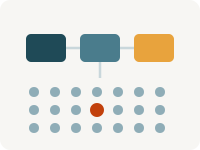
A hundred and up
Large: stop recharging costs by eye
Three hundred people across a co-operative and its host farms. Every hour knows who pays for it, where it was worked and which cost centre it goes to — three separate things, and they stay separate. The lists hold thousands of rows, and every role sees its own part and not the rest.
What goes away: the cost split done from memory at the end of the quarter.
The right question is not how many people you have, but how many muster points and how many phones.
How much it takes
The numbers we measured ourselves.
- 3 millionclock-ins tested on a single machine
- 6languages in the worker’s app
- 0GPS coordinates collected, ever
There are other sections that do not fit here — absences and leave, documents for the worker, closing a period, gaps against the agreement. They are easier to look at together than to read about.